
The future of Indonesia–Vietnam relations is highly promising. Together, Indonesia and Vietnam can play a greater role in shaping the future of ASEAN and the Indo-Pacific region.
This was shared by Rachmat Pambudy, Indonesia’s Minister of National Development Planning, during a meeting of the Indonesia–Vietnam Friendship Association in Jakarta, Indonesia.
Indonesia–Vietnam cooperation entering a new era
Minister Rachmat Pambudy noted that Indonesia–Vietnam relations have achieved significant progress in recent years, built upon a long-standing history of solidarity between the two nations. At one point, Indonesia’s success in achieving food self-sufficiency attracted widespread attention across the region. Vietnam was among the countries that closely studied Indonesia’s agricultural transformation. This reflects the spirit of mutual learning among developing countries.
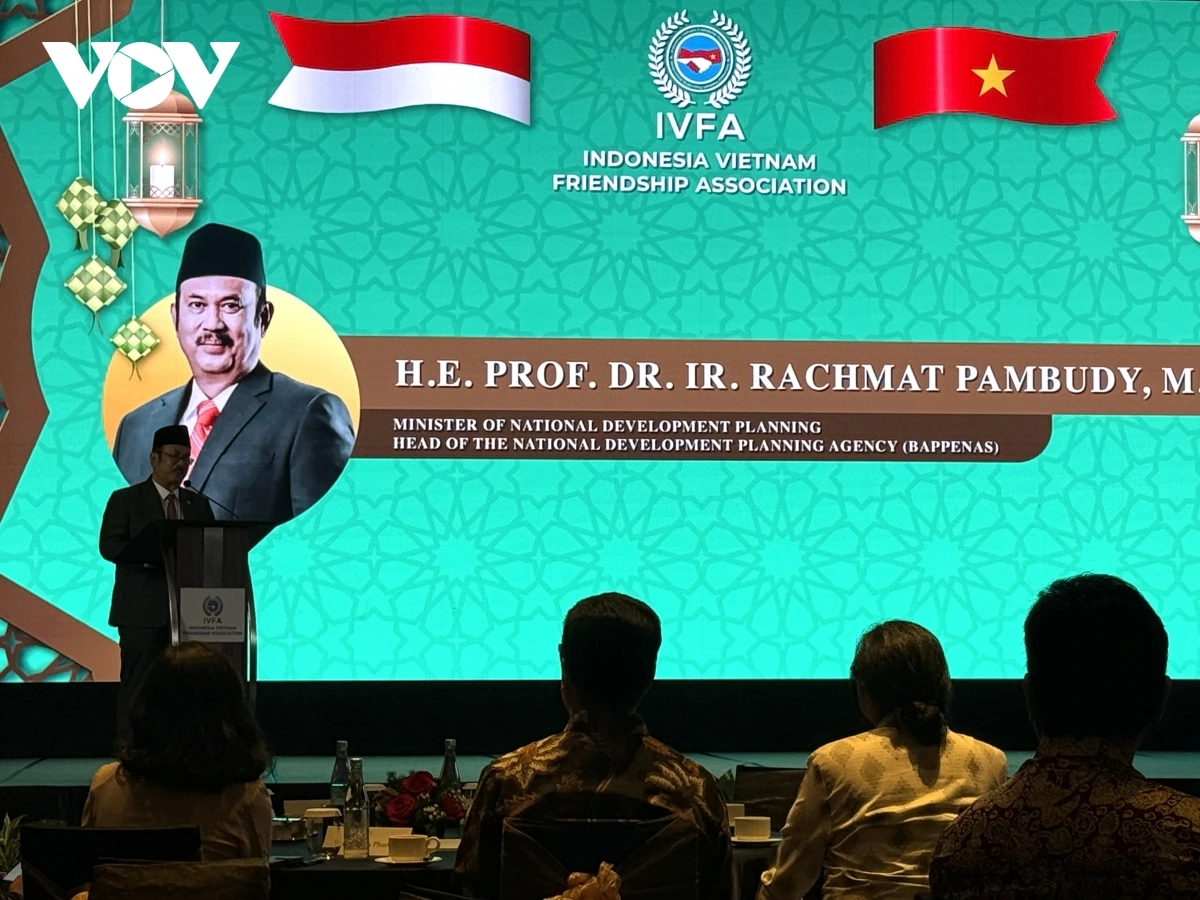
Minister of National Development Planning Rachmat Pambudy during the meeting of the Indonesia–Vietnam Friendship Association in Jakarta, Indonesia.
However, today both sides have witnessed a significant transformation. Vietnam has advanced at an extraordinary pace, developing strong manufacturing capabilities, building competitive export industries, and rapidly expanding sectors such as automobile manufacturing, electronics, and high-value industrial production. The Minister highly praised Vietnam’s progress in recent years, affirming that Indonesia–Vietnam relations are entering a new era.
A Growth Driver for Southeast Asia
Indonesia’s Minister of National Development Planning, Rachmat Pambudy, stated that both Indonesia and Vietnam are emerging economies, serving as key growth drivers in Southeast Asia and pillars of ASEAN, contributing to the future development of the region.
Indonesia’s development direction is guided by the National Medium-Term Development Plan (RPJMN) 2025–2029. Through this plan, Indonesia aims to gradually increase its economic growth to 8% by 2029. However, Rachmat Pambudy emphasized that growth is not the ultimate objective. Growth must reduce poverty, strengthen human capital, and create opportunities for future generations. Economic growth will be driven by focusing on several key pillars:
- Social infrastructure, reflecting investment in people. Indonesia aims to improve the quality of its human resources, particularly by providing better education, healthcare, and social protection.
- Physical infrastructure, especially enhancing connectivity to reduce logistics costs, expand domestic markets, and effectively link regions with major growth centers.
- Economic infrastructure, which is crucial for strengthening the production and distribution base. This includes encouraging downstream processing of natural resources, developing manufacturing industries, and empowering micro, small, and medium-sized enterprises (MSMEs) as well as cooperatives.
- Digital infrastructure and governance reform, serving as key drivers of the domestic economy through digitalized public services, integrated data systems, and more efficient business processes.
Indonesia is accelerating its digital development through several pillars: strengthening digital infrastructure across the archipelago; expanding digital government and public services; developing digital talent and innovation ecosystems, including artificial intelligence; building strong global partnerships in digital innovation; and promoting cooperation in electronics and semiconductor (chip) manufacturing.
The Minister emphasized that the future of Indonesia–Vietnam relations is highly promising. Both countries have dynamic economies, young and productive populations, and increasingly aligned development visions. Together, Indonesia and Vietnam can play a greater role in shaping the future of ASEAN and the Indo-Pacific region. More importantly, the two countries can demonstrate to the world that Southeast Asian nations are not merely participants in global change, but are becoming drivers of transformation.
Promising Cooperation Initiatives
The Minister noted that as cooperation between Indonesia and Vietnam becomes increasingly important, the partnership must also continue to evolve. Cooperation should not be limited to traditional exchanges but should expand into new areas of collaboration. Vietnam has developed impressive capabilities in technology and digital innovation, creating new opportunities for deeper cooperation in shaping the digital future of Southeast Asia.
The Minister highlighted several promising initiatives, including: First, cooperation between Bappenas and CT Group in developing policies and an ecosystem for the Low-Altitude Economy, supporting Indonesia’s national digital transformation. In August 2025, Bappenas established a strategic partnership with CT Group Vietnam on the Low-Altitude Economy and the National Digital Twin Model in Indonesia, formalized through the signing of a Memorandum of Understanding (MoU). Following this, Indonesia is working to develop a National Roadmap for the Low-Altitude Economy, alongside the development of a National Digital Twin technology framework, expected to be completed by May 2026.
Second, Indonesia is also exploring opportunities for cooperation with FPT Vietnam in the fields of artificial intelligence and digital transformation. Bappenas and FPT Vietnam signed a Memorandum of Understanding on June 12, 2025, to strengthen cooperation in several strategic areas, including national digital transformation, digital talent development, artificial intelligence, green technology, smart cities, and digital economy strategy.
Third, cooperation between the two countries continues to expand in agriculture and agribusiness. Companies such as Japfa and TH Group are strengthening collaboration in food production and agricultural business development.
Fourth, beyond agriculture, there are also promising opportunities for cooperation in the fisheries sector. Indonesia possesses one of the largest maritime and fishery resources in the world, but its fishing fleets and equipment still need strengthening. Meanwhile, Vietnam has strong industrial fishing capabilities. This creates a natural opportunity for complementary cooperation – combining Indonesia’s vast marine resources with Vietnam’s expertise in industrial fisheries.
Fifth, there are also opportunities in real estate and urban development, as both Indonesia and Vietnam are experiencing rapid urbanization and increasing demand for modern housing and integrated urban development.
Sixth, in the fields of healthcare and biotechnology, there is also strong potential for cooperation. One example is Vaksindo, a company established in 1983 specializing in the development of animal vaccines based on scientific research and modern biotechnology. Today, its products are exported to more than 24 countries across Asia, the Middle East, and Africa, supported by manufacturing facilities in Indonesia, Vietnam, and India. This reflects how Indonesia and Vietnam can strengthen cooperation in biotechnology, animal health, and regional health security, while contributing to building a more sustainable and resilient food system.
According to the Minister, friendship between nations is nurtured through trust, dialogue, and shared experiences. The relationship between Indonesia and Vietnam is not only about economics, but about two nations that share confidence in a common future – a future where people prosper, economies grow stronger, and Southeast Asia confidently shapes its own destiny.