
In the tourism industry, guest experiences are shaped not only by room quality but also by surrounding landscapes, privacy, comfort, and spatial design. As flexible accommodation models continue to evolve, modular construction is creating new opportunities for developers. Building on this approach, CT Modulex’s automatic folding and unfolding robotic housing technology introduces a new way to combine transportation flexibility, deployment capabilities, and adaptable spaces designed to meet diverse hospitality needs.
FROM STANDALONE RESORT CABINS TO ACCOMMODATION COMPLEXES: WHERE CAN ROBOTIC HOMES BE APPLIED?
Not every resort development requires the same construction approach. An eco-resort may prioritize standalone cabins surrounded by nature, while a hotel or large-scale accommodation complex may require multiple rooms with standardized layouts to support efficient operations.
By organizing spaces into prefabricated components and modules, modular construction can accommodate a wide variety of hospitality models.
Standalone Cabins and Villas in Resorts
For eco-resorts, luxury glamping destinations, and nature-based accommodation, standalone cabins can provide guests with greater privacy and a closer connection to their surroundings.
Each unit can be designed around the needs of different guest segments. Accommodation for couples may prioritize relaxation areas, scenic views, and privacy, while family-oriented units may require larger shared living spaces, additional storage, and amenities suitable for longer stays.
A notable example is Piaule Catskill in New York, USA, a resort featuring 24 individual cabins nestled within the natural landscape and connected by short walking paths.
According to Core77 Design Awards, the project incorporates prefabricated cabins designed to complement the surrounding terrain and environment.
Rather than concentrating all guest rooms in a single building, this dispersed arrangement allows each cabin to offer distinct views and varying degrees of privacy.
For CT Modulex, this model highlights the potential application of robotic homes as standalone resort accommodation, with spatial configurations developed according to specific guest requirements and site characteristics.
Phased Resort Expansion
Not every resort develops its full accommodation capacity from the outset. Many properties expand gradually based on market demand, operational performance, and investment plans.
In such cases, developers may consider adding clusters of guest rooms or standalone accommodation units in suitable areas within the existing resort.
For example, an operating resort could introduce a group of family-oriented villas near shared amenities while positioning more secluded accommodation in quieter areas of the property.
However, expansion involves more than simply adding rooms. Developers must consider connections between accommodation clusters, utility infrastructure, guest circulation routes, and the operational capacity of the existing property.
For resorts that continue welcoming guests during expansion, transportation and installation plans must also be carefully coordinated to minimize disruptions to ongoing operations.
These are among the challenges that CT Modulex’s compact folding design and automatic folding and unfolding technology aim to address.
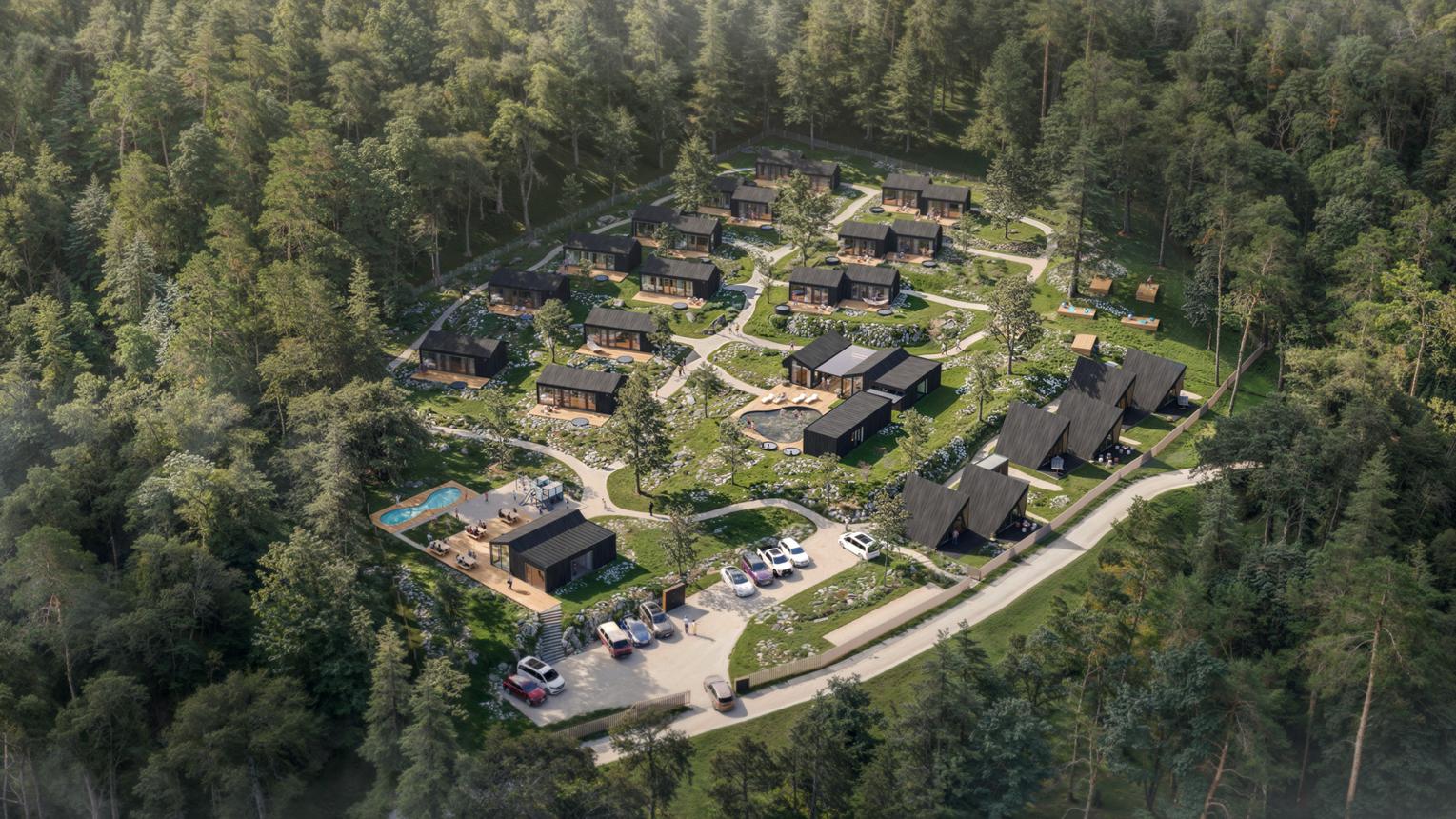
Concept rendering of a modular resort featuring accommodation clusters connected by walkways and shared facilities.
Hotels and Accommodation Facilities with Standardized Room Layouts
For hotels and large-scale accommodation facilities, standardizing room types can provide advantages in design, manufacturing, and operational management.
Rooms with similar functions can be developed as modules featuring consistent bathroom layouts, technical systems, and interior arrangements. These modules can then be installed according to the overall building design.
According to the Modular Building Institute, modular construction has been adopted across various hospitality developments, from urban hotels to resort properties.
One example is Duffin Cove Oceanfront Lodging in Canada, where the expansion included two modular accommodation buildings containing a total of 18 suites, alongside a separate building for reception and staff housing. Walkways connect the different areas, creating an integrated hospitality complex.
The project demonstrates how modular construction can be applied not only to individual accommodation units but also to larger developments requiring coordinated guest facilities and supporting spaces. (Source: Modular Building Institute)
For CT Modulex robotic homes, hospitality developments with standardized room configurations represent another potential application to explore, depending on spatial requirements, building connections, and the technical conditions of each project.
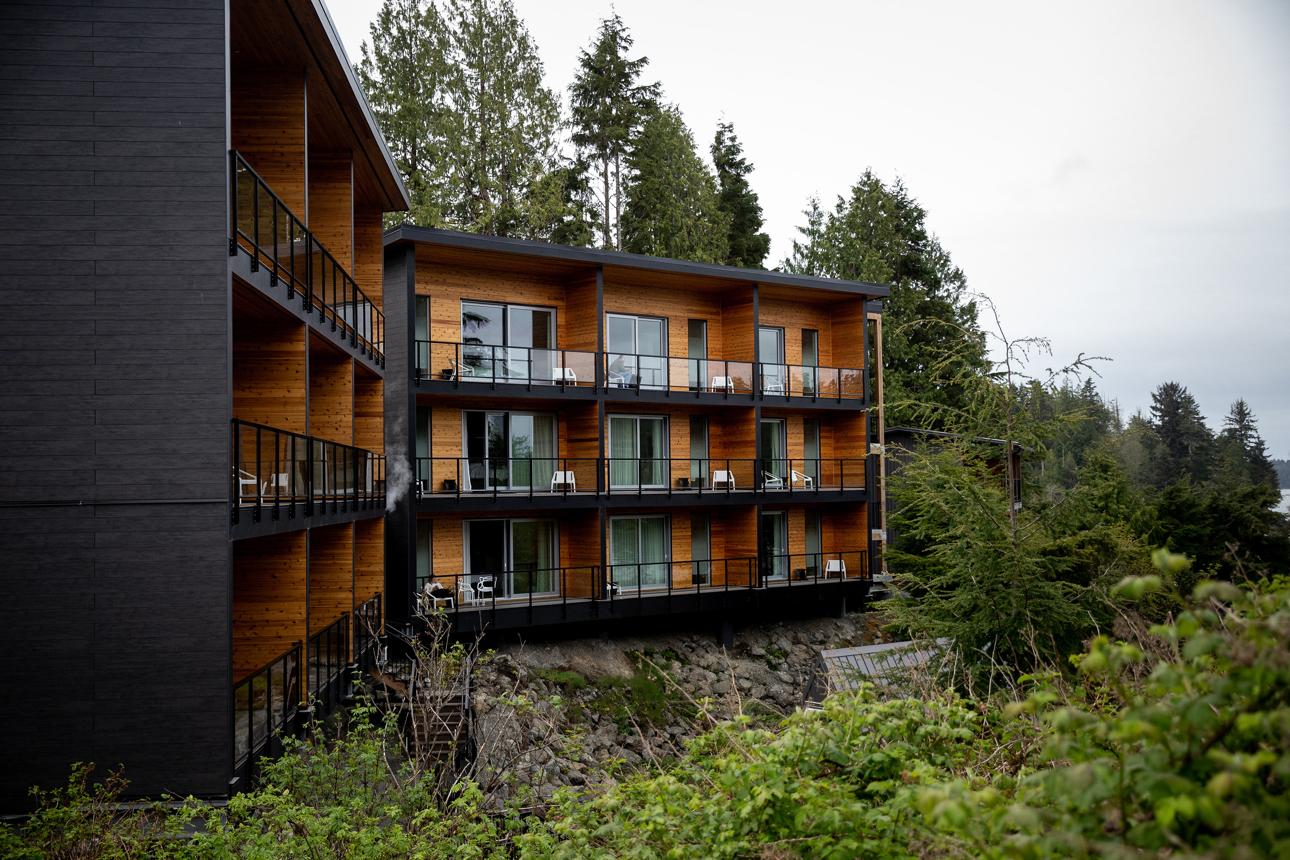
Duffin Cove Oceanfront Lodging in Canada demonstrates the use of modular construction to develop multi-story guest accommodation.
THE GUEST EXPERIENCE BEGINS WITH SPATIAL DESIGN
An attractively designed cabin does not necessarily deliver a positive guest experience if its location, accessibility, or connection to surrounding amenities is poorly planned.
In resort development, spatial design should begin with the guest journey, from check-in to the use of facilities throughout the stay.
Scenic Views and Privacy
For nature-oriented resorts, scenic views and privacy are two important factors influencing the accommodation experience.
A cabin overlooking the sea or mountains may occupy an attractive location. However, if its entrance or outdoor terrace directly faces a neighboring unit, guest privacy may be compromised.
Therefore, the arrangement of accommodation units should consider views, spacing between buildings, entrance locations, sun exposure, and access routes.
For resorts featuring multiple units with similar configurations, developers may consider adjusting building orientation or outdoor layouts to create distinctive experiences across different locations.
Amenities That Match the Length of Stay
Guest needs vary depending on the purpose and duration of their visit.
Short-stay visitors may prioritize comfortable sleeping areas, well-equipped bathrooms, and spaces for enjoying the surrounding scenery. Meanwhile, long-stay guests and families often require additional luggage storage, shared living areas, and amenities that support everyday activities.
The size and layout of accommodation units should therefore be determined by the target guest segment rather than architectural appearance alone.
With a focus on adaptable design, CT Modulex is exploring robotic home configurations that can accommodate different spatial layouts and functions to serve a variety of user needs.
Accessibility and Connectivity Between Facilities
A resort typically includes several functional areas, such as reception, restaurants, swimming pools, shared facilities, and accommodation clusters.
Distances between these areas should be carefully considered to ensure convenient movement throughout the property.
For accommodation units located on sloping terrain or spread across a large resort, developers must account for accessibility, particularly for older guests, families with young children, and visitors carrying heavy luggage.
Walkways, lighting systems, and connections to shared facilities should be planned alongside the overall building layout.
An effective hospitality solution must do more than provide comfortable rooms; it should create a seamless experience throughout the entire resort.
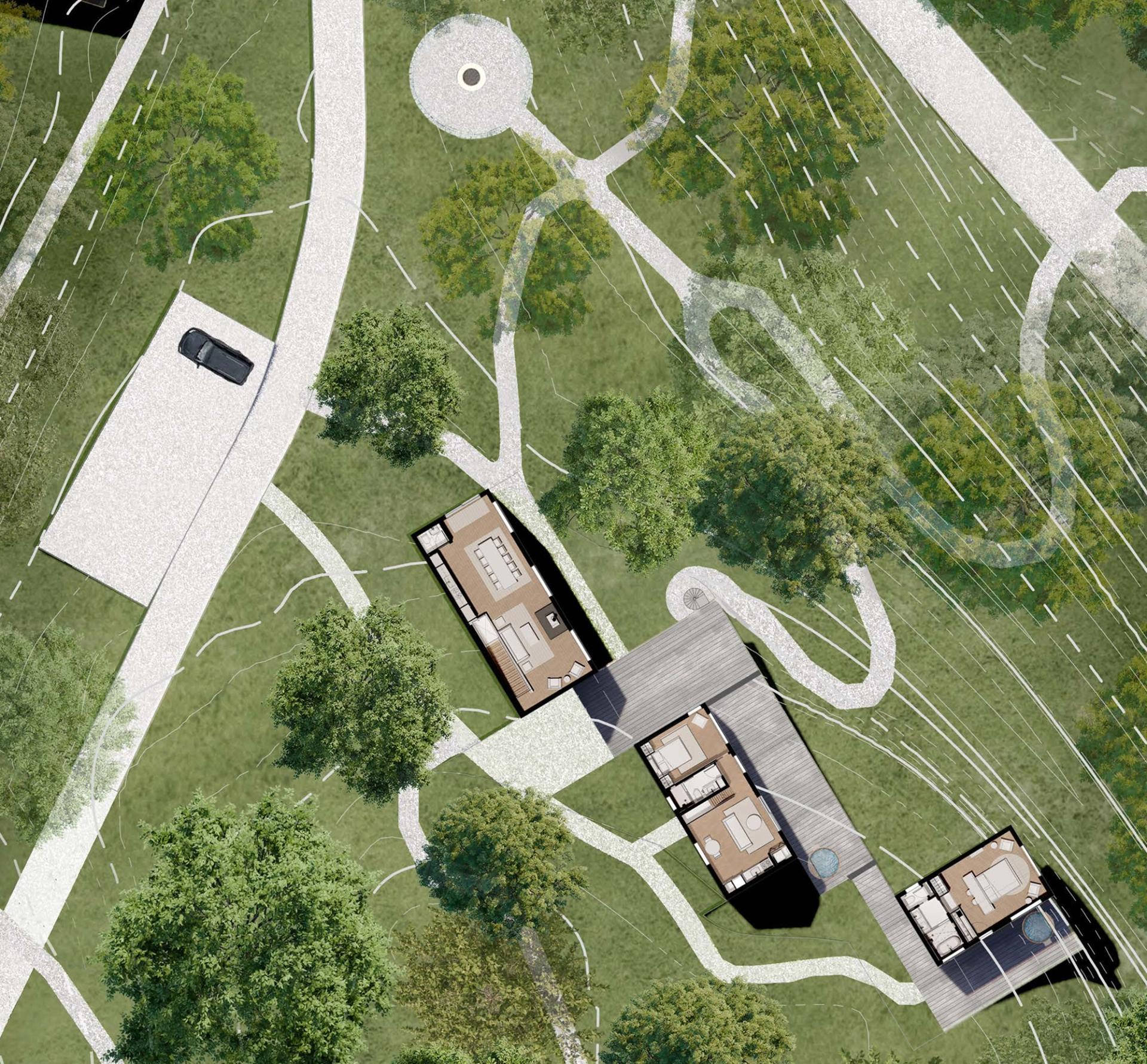
Conceptual resort site plan illustrating the arrangement of accommodation units, circulation routes, and shared facilities.
FROM DESIGN TO DAILY OPERATIONS: KEY CONSIDERATIONS FOR DEVELOPERS
Beyond guest experience, operational efficiency is an important factor in the long-term performance of a hospitality development.
For resorts with dispersed accommodation units, housekeeping, maintenance, and supply distribution must be organized according to the property’s layout.
Organizing Housekeeping and Guest Services
A resort with multiple standalone cabins can offer guests greater privacy, but it also requires operational teams to travel between different locations to carry out daily tasks.
The distance between linen storage and individual units, waste collection routes, and supply delivery paths can all influence operational efficiency.
If service routes pass through reception areas or quiet guest spaces, they may also affect the visitor experience.
Therefore, resort layouts should account for both guest circulation and staff service routes rather than focusing exclusively on the positioning of accommodation units.
Maintenance Accessibility and Convenience
For accommodation facilities with multiple rooms of the same category, standardizing equipment and certain technical components can simplify spare-part management and maintenance preparation.
However, developers still need to ensure suitable access to electrical systems, plumbing, air conditioning, and other components requiring periodic inspection.
For example, when several accommodation units share a water supply line, the system should be designed to allow inspection and repairs while minimizing disruptions to other occupied rooms.
For robotic homes incorporating automatic folding and unfolding technology, maintenance planning must also consider control systems, mechanical drives, and relevant structural connections.
Preparing Buildings for Guest Occupancy
Before welcoming guests, accommodation units must be inspected to verify their suitability for use, utility connections, and the operation of technical systems.
For developments implemented in phases, inspections and evaluations at each stage allow developers to identify necessary improvements before proceeding with subsequent accommodation clusters.
This is particularly important for operating resorts, where new construction activities must be coordinated with existing hospitality services to minimize interruptions.
HOW DOES CT MODULEX APPROACH THE DEPLOYMENT OF HOSPITALITY FACILITIES?
Beyond design and operations, transporting and installing buildings at their intended locations is another important consideration for resort developments.
For resorts located in remote areas, properties with limited site access, or facilities expanding while remaining operational, transportation and construction logistics can significantly influence project implementation.
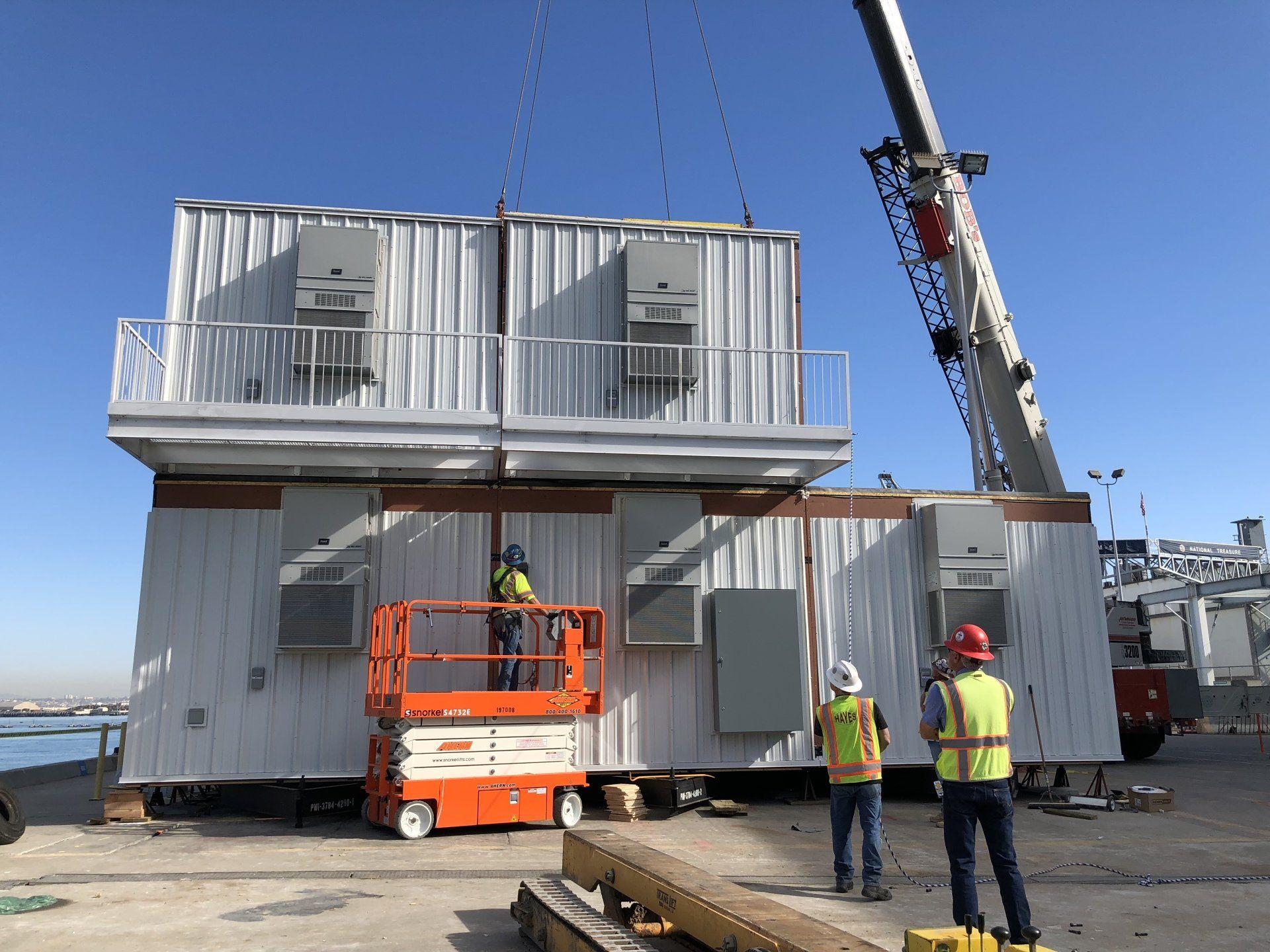
The process of lifting and positioning prefabricated modules at a construction site illustrates the transportation and installation requirements of modular construction.
Different construction methods involve different approaches to manufacturing, transportation, and on-site installation.
| Construction Method | Deployment Approach | Key Considerations |
|---|---|---|
| Traditional Construction | Building materials are transported to the site, where most construction activities take place. | Material storage areas, construction schedules, and impacts on surrounding facilities. |
| Panelized Construction | Prefabricated wall, floor, and roof panels are transported to the site for assembly. | Panel storage, labor requirements, and on-site assembly procedures. |
| Volumetric Modular Construction | Prefabricated three-dimensional modules are transported to the site for positioning and installation. | Transportation dimensions, site accessibility, and lifting equipment. |
| CT Modulex Robotic Homes | The building is transported in a compact folded configuration and automatically unfolded at the installation site. | Folded dimensions, required unfolding space, foundation preparation, and utility connections. |
According to a World Bank publication, prefabricated construction can be organized through different methods, including panelized systems and three-dimensional volumetric modules, each with distinct transportation and installation requirements.
Building on this foundation, CT Modulex is researching and developing robotic homes designed to fold into a compact configuration for transportation and automatically expand into functional spaces at the installation site.
Compact Folding Design for More Efficient Transportation
For buildings with a high level of prefabrication and interior completion, module dimensions can influence transportation arrangements and accessibility to the project location.
CT Modulex approaches this challenge through a design that allows the building structure to be folded into a more compact configuration before transportation.
The solution aims to improve the use of available transportation space while providing a foundation for exploring delivery options suited to long-distance projects or sites with restricted access.
For example, a resort planning to add accommodation units in an area deep within its property could evaluate the robotic home’s folded dimensions alongside internal road widths, turning radii, and unloading locations.
However, actual deployment feasibility must still be assessed using verified product specifications and the conditions of each project.
Automatic Folding and Unfolding Technology to Support Deployment
Unlike construction approaches that require numerous individual components to be assembled on-site, CT Modulex robotic homes are being developed with a mechanism that transforms the building from a compact folded configuration into a usable space through an automatic folding and unfolding system.
This technology aims to simplify deployment procedures and reduce reliance on manual folding and unfolding operations.
For resort developments, this capability offers a potential alternative worth considering when adding new accommodation within an existing operating property.
Nevertheless, deployment still requires suitable site conditions, sufficient clearance for the unfolding mechanism, electrical and plumbing connections, and technical inspections before the building can be occupied.
Flexible Design for Different Hospitality Models
A standalone cabin surrounded by nature, a cluster of family-oriented villas, and project-based accommodation each have different requirements in terms of space and functionality.
Through its modular design approach, CT Modulex is exploring ways to adjust spatial configurations, material selections, and amenities to suit different applications.
This creates potential opportunities for robotic homes across various tourism and hospitality models, from individual resort cabins to larger groups of buildings organized within a master-planned development.
However, the suitability of each solution must be evaluated based on functional requirements, structural design, site conditions, applicable building standards, and actual operational needs.
FROM CONSTRUCTION SOLUTIONS TO LONG-TERM VALUE IN HOSPITALITY
In the tourism and hospitality industry, a construction solution delivers meaningful value only when it meets both guest expectations and developers’ operational requirements.
Accommodation spaces must provide comfort and privacy, while deployment methods need to align with site conditions, infrastructure, and ongoing operations.
For CT Modulex, automatic folding and unfolding robotic housing technology represents an opportunity to combine adaptable design, more efficient transportation planning, and automated deployment.
From standalone resort cabins to accommodation clusters serving different guest segments, the potential of robotic homes lies in developing spatial solutions that respond to specific business models and user needs.
The success of a resort development depends not only on how its buildings are delivered and brought into operation, but also on its ability to maintain guest satisfaction and create long-term operational value.
Explore the applications of CT Modulex robotic homes or contact us to discuss solutions suited to your project’s scale, site conditions, and development objectives.